Materialities (key issues)
The DBJ Group has identified its materiality issues by not only drawing upon international guidelines but also placing an emphasis on dialogue with its various stakeholders. We have deepened our understanding of three priority areas of focus for the realization of a sustainable society while providing solutions in tune with the times, and these three priority areas have been narrowed down and crystallized as materiality issues. Looking ahead, we plan to review our materiality issues periodically from the perspective of balancing economic and social value while maintaining dialogue with our stakeholders.
Materiality of the DBJ Group (Key Management Issues)

Formation of sustainable infrastructure
|
|
|---|---|

Technical innovation and restructuring of industry
|
|

Regional revitalization utilizing untapped potential
|
|

Creation of markets and safety nets in the finance sector
|
|

Cultivation of talent to challenge financial frontiers
|
|

Strengthening of the business foundation for supplying risk capital
|
|
Materiality Identification Process
The DBJ Group has identified its materiality issues by not only drawing upon international guidelines but also placing an emphasis on dialogue with its various stakeholders. We have deepened our understanding of three priority areas of focus for the realization of a sustainable society while providing solutions in tune with the times, and these three priority areas have been narrowed down and crystallized as materiality issues. Looking ahead, we plan to review our materiality issues periodically from the perspective of balancing economic and social value while maintaining dialogue with our stakeholders.
Deepening Our Understanding of the Three Priority Areas
In light of the roles and functions we have performed to date as well as realizing social value and future changes, we have designated infrastructure, industry, and regions as our priority areas.
Despite changes in the external environment, these priority areas have remained consistent over time, and we reaffirmed their importance in the materiality identification process.

- Infrastructure
Rebuilding of energy systems, development of more advanced transportation networks, and creation of attractive communities

- Industry
Commercialization of new technologies, restructuring of businesses to improve productivity and sharpen competitiveness, and business development in global markets

- Regions
Industrial revitalization based on regional characteristics, overseas business development, foreign tourism in Japan, and business succession
Discovery of Materiality Issues through Dialogue with Stakeholders
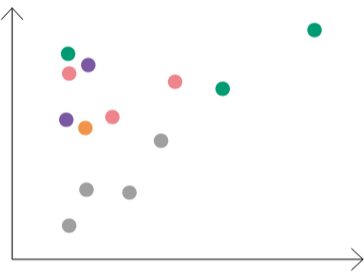
After selecting the 37 social issues with reference to the basic policies of the Japanese government and internal DBJ Group discussions about problems faced by customers, we analyzed each issue from two perspectives—importance to stakeholders and importance to the DBJ Group’s business—and narrowed the list down to 13 social issues.
- Importance to Stakeholders
We conducted quantitative evaluations through surveys of each department, branch, and Group company, as well as staff and executive meetings on several occasions, and discussions with experts, while referring to SASB* and other guidelines.
- Importance to the DBJ Group’s Business
We conducted quantitative evaluations of the importance of the issues to the DBJ Group’s business in the context of different capital resources.
- *SASB: Sustainability Accounting Standards Board
We grouped the 13 social issues under three main issues—Decarbonization, New business creation, and Population decline, and a common theme comprising financial markets and risk capital.
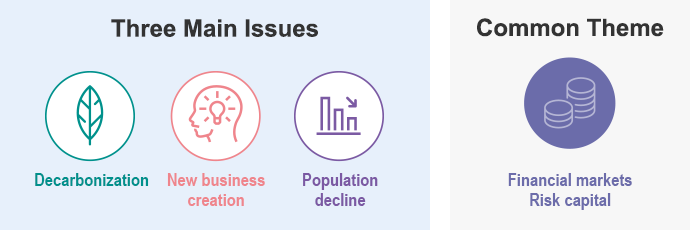
Priority Areas, Main Issues, and Common Theme
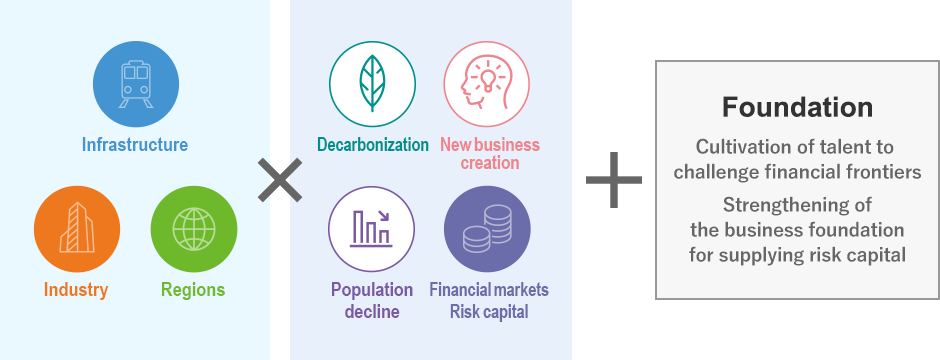
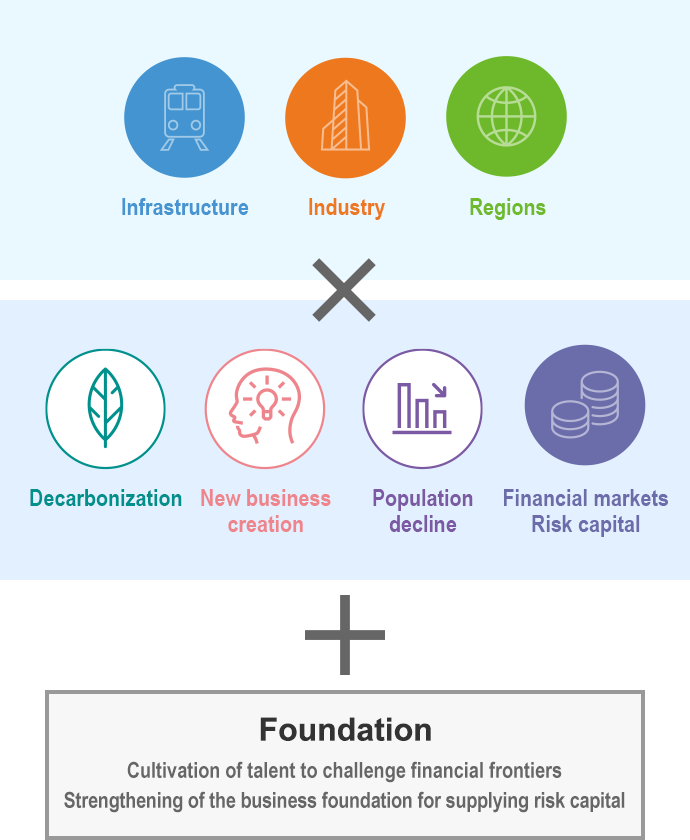
We are adding foundational initiatives to support our activities in the three priority areas over the long term and to address the four main themes discovered in our dialogues with stakeholders.