LBOs / MBOs
About Leveraged Buyouts (LBOs)
A leveraged buyout (LBO) is an M&A arrangement in which a company or business is acquired using borrowed money. If the company or business that is being acquired generates steady cash flows, the acquirer (typically, the sponsor providing equity) can reduce the size of its equity investment by financing the purchase to a large extent with borrowed money. Buyout funds, which actively use borrowed money to maximize return, are the main players in M&A LBOs.
About Management Buyouts (MBOs)
A management buyout (MBO) is the purchase of a company, its operations, or its assets by the company’s management team. Because the management team typically has a limited amount of cash available, in most cases it needs to procure a loan to acquire the business. Therefore, an MBO frequently takes the same form as an LBO. In some cases the total required funding cannot be procured through a loan alone; so, the management team partners up with a buyout fund to jointly provide equity.
Other possible reasons to execute an MBO include to take a public company private or to function as a succession plan for an owner-operator company. Executing an MBO makes it possible to stabilize management by preventing the dilution of shares when the management team takes over the company from its current owner.
DBJ, as a financial advisor, addresses the diverse needs of its clients, including bringing together the MBO overall, financing arrangements, providing mezzanine financing, and making equity investment with a joint sponsor.
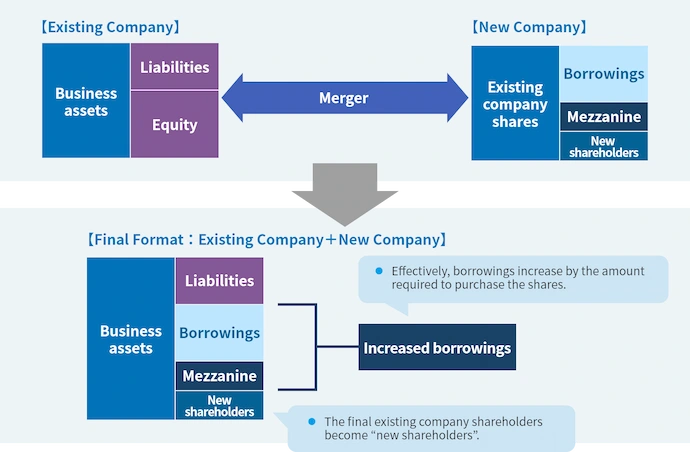
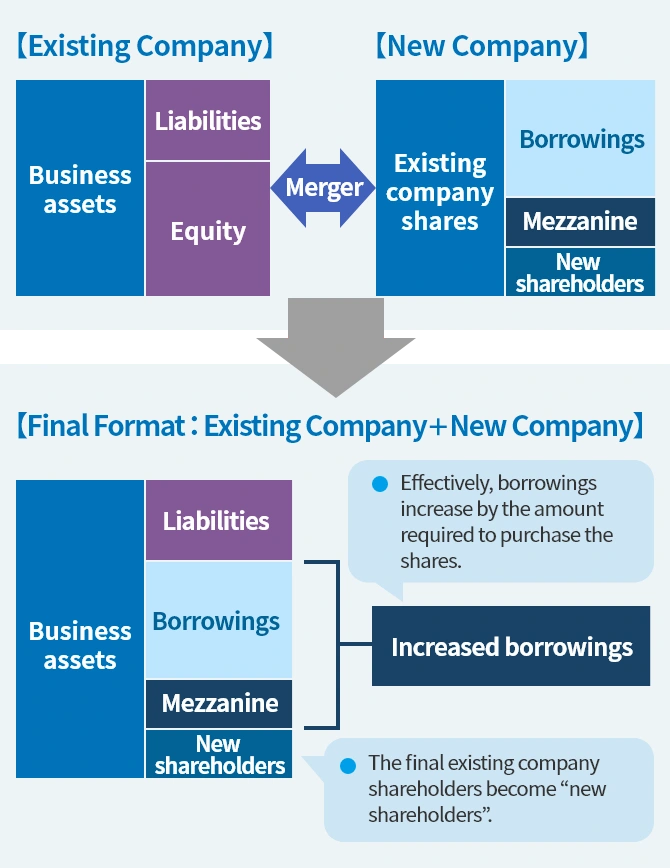
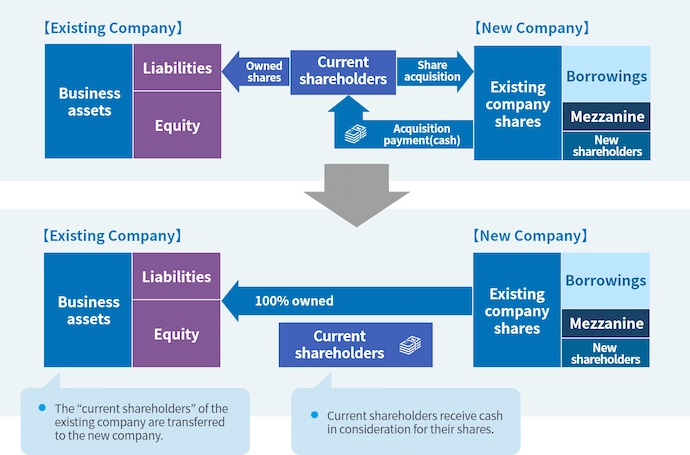
Scheme(MBO)
First Step
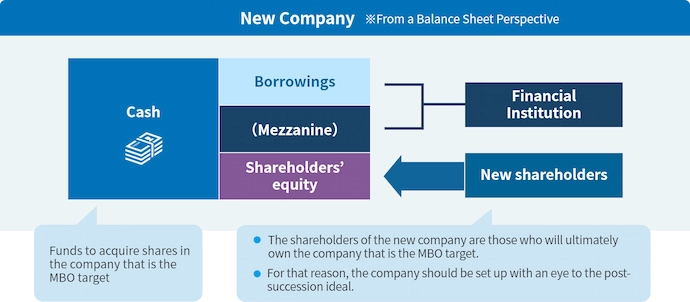
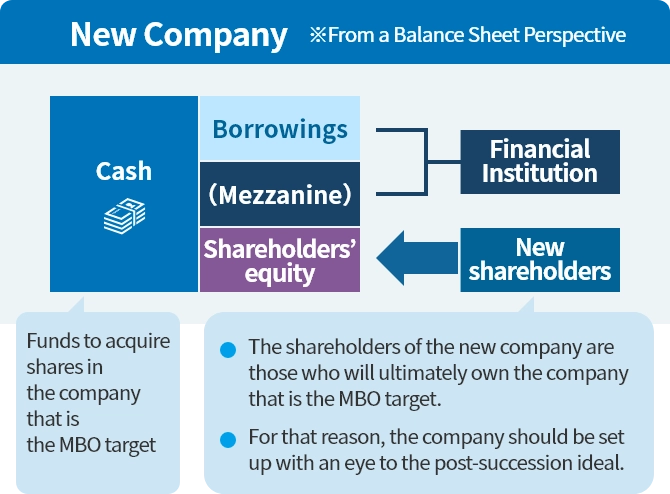
Establish new company to serve as the conduit for share acquisition.
Second Step
The new company accumulates shares from existing shareholders.
Third Step
Your company merges with the new parent company.