
Efforts to preserve natural capital and biodiversity (disclosure based on the TNFD recommendations)
Governance
For the DBJ Group's governance system, please see the Sustainability Management System page.
Strategy
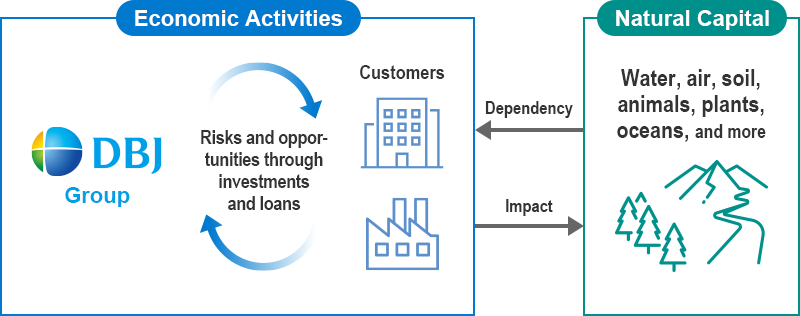
The DBJ Group recognizes that it is dependent on and impacts natural capital not only through its own activities, but also through the economic activities of its investment and loan customers. The DBJ Group seeks to identify the risks and opportunities arising from the interdependence between economic activities and natural capital, and to contribute to the transition to a nature-positive economy by supporting customer initiatives.
Examples of DBJ Group initiatives for natural capital and biodiversity
| Finance |
|
|---|---|
| Knowledge |
|
| Partnership |
|
Risk Management
Our Policy on Investments and Loans with Environmental and Social Considerations defines our policy aims for investment and loan activities in the financing of businesses and specific sectors that are likely to pose significant risks or negative impacts on the environment and society. In line with the Equator Principles, the business units and the Structured Finance Department (specifically, the Environmental & Social Assessment Office) identify, assess, and monitor environmental and social risks in project finance and related activities.
Metrics and Targets
| Target | Actual | |||
|---|---|---|---|---|
| GRIT-related investment and loan amounts (cumulative since fiscal 2021) | ¥5.5 trillion | Fiscal 2025 | ¥4.6 trillion | Fiscal 2024 |