
Climate Change Initiatives (Disclosure Based on TCFD Recommendations)
The DBJ Group aims to achieve net zero greenhouse gas (GHG) emissions by 2050, striving to help create a decarbonized society while balancing climate action with stable energy supply and other needs. The Group has established a policy of actively supporting customers’ transition efforts while strengthening engagement activities, such as holding constructive dialogues in order to propose solutions tailored to customer-specific issues. The DBJ Group has set quantitative reduction targets for, and measures and tracks, its own GHG emissions (Scope 1 and 2) as well as emissions from its investment and loan portfolio (Scope 3).
Governance
Strategy
Basic Approach to Carbon Neutrality
Since the adoption of the Paris Agreement in 2015, various governments, industry associations, and corporations have declared their intentions to work toward a decarbonized society, and they have accelerated actions toward mitigating and adapting to climate change. The Japanese government also declared a goal of achieving carbon neutrality by 2050 in October 2020, and it is promoting various policies in support of this goal. Against this backdrop, we believe it is important to explore realistic transitions based on actual conditions in each country and region, instead of taking a one-sided approach to becoming carbon neutral, as it is essential to preserve social stability and sustainability. As Japan moves along the path to carbon neutrality, it will be important to facilitate a transition that balances carbon neutrality initiatives with measures to ensure a reliable supply of energy, while considering the potential for energy demand to expand in the future as digitalization advances. By promoting the development of breakthrough innovative technologies, Japan must maintain and reinforce the competitiveness of its industries while overcoming technical issues and the massive cost of becoming carbon neutral.
Transition Policy (Formulated in FY2023)
We provide financial support for initiatives that lead to reductions in GHG emissions based on the medium- to long-term transition plans of our customers in high-emitting industries. We aim to achieve net zero GHG emissions by 2050 by promoting transitions to decarbonization, including within regions. In an environment where uncertainties such as rising fuel prices and geopolitical risks are increasing, the DBJ Group provides financial support to high-emitting industries for investments in both decarbonization and a sustainable society, and although this may temporarily increase the GHG emissions allocated to DBJ, it is an essential step in the transition to a decarbonized society. We therefore intend to proactively provide financing that facilitates transitions by our customers. In order to address decarbonization across industries and regions, we will not only solve problems through financing but also strengthen our support in terms of proposals to stakeholders in industries and regions, as well as offer knowledge. Moreover, we will actively support our customers in terms of providing capital to startups working on innovations, such as climate tech and new technologies like nuclear fusion.
Engagement Activities
With the objective of achieving net zero GHG emissions in its investment and loan portfolio by 2050, the DBJ Group supplies risk capital for new technologies and climate tech, in addition to providing sustainable financing, advisory services, and consulting services, in order to support customer initiatives in decarbonization.
When providing investments and loans, advisory services, and consulting services, DBJ encourages constructive engagement with its customers, thereby deepening its understanding of issues affecting customers and industries. While bringing attention to problems and presenting hypotheses to customers, the DBJ Group is committed to helping them solve such issues. Through these initiatives, we focus on engagement activities in line with our Transition Policy. More specifically, we disseminate knowledge and advice to governments, regions, and industry groups, while engaging in constructive dialogues with customers, in order to help customers solve their issues.
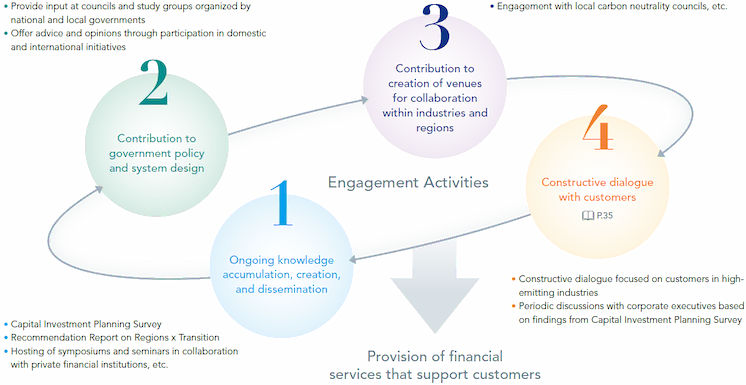
- 【The four “Engagement Activities” form a cycle that ultimately leads to the “Provision of financial services that support customers】
-
- 1Ongoing knowledge accumulation, creation, and dissemination
- Capital Investment Planning Survey
- Recommendation Report on Regions x Transition
- Hosting of symposiums and seminars in collaboration with private financial institutions, etc.
- 2Contribution to government policy and system design
- Provide input at councils and study groups organized by national and local governments
- Offer advice and opinions through participation in domestic and international initiatives
- 3Contribution to creation of venues for collaboration within industries and regions
- Engagement with local carbon neutrality councils, etc
- 4Constructive dialogue with customers
- Constructive dialogue focused on customers in highemitting industries
- Periodic discussions with corporate executives based on findings from Capital Investment Planning Survey
- 1Ongoing knowledge accumulation, creation, and dissemination
Constructive dialogue with customers
Ideal Approach
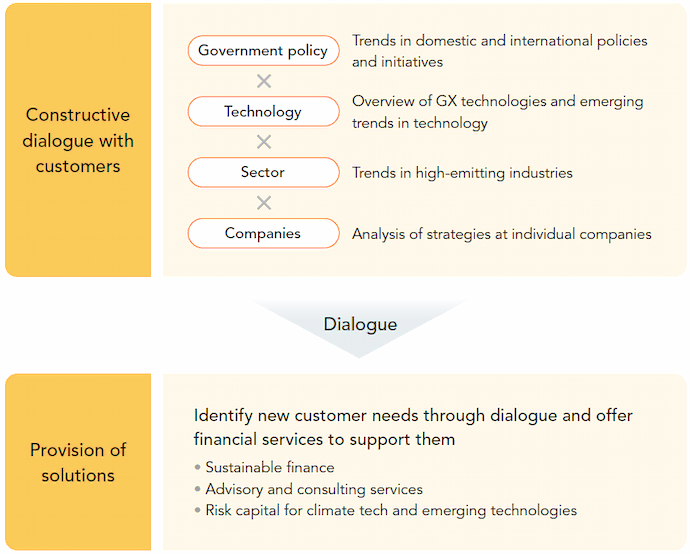
We deepen our understanding of challenges faced by customers through constructive dialogue (engagement) with them, based on accurate analysis of trends in government policy, technology, and industry, as well as each customer’s business strategy. At the same time, the DBJ Group offers problem-solving ideas and hypotheses to customers, and explores how best to support them in addressing their challenges.
Specific Examples of Initiatives
- Constructive Dialogue Centered on Customers in High-Emitting Sectors
For sectors with companies that have set interim emissions reduction targets for 2030, such as the electric power and oil & gas sectors, we engage in constructive dialogue informed by the DBJ Group’s quantitative simulations of future scenarios, assisting customers with their initiatives and issues related to decarbonization. We are also enhancing engagement with companies in other high-emitting sectors to deepen constructive dialogues.
- Promotion of Cross-Sector Initiatives
Hydrogen, ammonia, and storage batteries, which are new energy carriers that will be key in the transition to a carbon-free society, require cross-sector and crossregional initiatives. In light of this, DBJ has established a Groupwide informationsharing platform to enhance our constructive dialogues with customers.
- Routine Discussions with Corporate Executives
Since 1956, DBJ has conducted the Capital Investment Planning Survey to better understand underlying trends in capital investment in Japan’s industrial sector. Referring to the results of this survey, we have discussions and exchange opinions with corporate executives on topics including decarbonization.
Analysis of Climate-Related Risks
We are aware of climate-related financial risks in terms of transition risks and physical risks. Transition risks could impact the business strategy of the DBJ Group by increasing credit costs if the creditworthiness of the recipients of its investments and loans declines due to lower sales and higher costs, mainly from the introduction of a carbon tax and upgrades to low-carbon technologies. Physical risks might also impact our business strategy by increasing credit costs if the creditworthiness of the recipients of our investments and loans declines due to damages to collateral value as a result of abnormal weather or supply chain disruptions.
DBJ analyzed scenarios for the energy sector (electricity and oil & gas) and the steel sector for transition risks, and scenarios for direct damage (damages to collateral value) and indirect impacts (business suspensions) due to water disasters for physical risks. The results of these analyses indicate that even if DBJ’s current balance of investments and loans were to stay the same, the financial impact would be limited to an acceptable level from a long-term perspective.
The DBJ Group is aware that the methodologies and data used to analyze financial risks related to climate change continue to evolve at a rapid pace. While monitoring trends in this field, we will adopt more advanced methods of analysis if necessary.
| Transition Risk | Physical Risk | |
|---|---|---|
| Risk event | Sudden change in policy toward net zero GHG emissions | Water damage (flooding) |
| Scenario | NGFS*1 Delayed Transition scenario | IPCC*2 RCP*3 8.5 (4.0ºC scenario) |
| Scope of analysis | Energy and steel sector | Damage to collateral value and impact of business suspensions due to water disasters |
| Assets covered | Balance of investments and loans | Balance of investments and loans |
| Analysis period | By 2050 | By 2100 |
| Analysis results (level of increase in credit costs) |
About ¥20.0–¥110.0 billion (cumulative) | About ¥10.0–¥30.0 billion (cumulative) |
- *1NGFS: Network for Greening the Financial System
- *2IPCC: Intergovernmental Panel on Climate Change
- *3RCP: Representative Concentration Pathways
Risk Management
Recognizing that inadequate preparedness for climate change poses a significant management risk, DBJ conducts scenario analyses to assess the impact of transition and physical risks, and formulates policies to address such risks. The Group is also enhancing data management and analytical methodologies under its ongoing risk management efforts. Progress with these initiatives is reported and discussed in forums such as the ALM and Risk Management Committee, which is under the Executive Committee.
Under its Policy on Investments and Loans with Environmental and Social Considerations, DBJ has established guidelines for financing businesses and sectors with a high likelihood of posing major risks or having negative consequences for the environment and society. In addition, based on the Equator Principles, the relevant business departments and the Structured Finance Department (Environmental and Social Risk Assessment Office), identify, assess, and monitor environmental and social risks associated with project finance and other transactions.
Metrics and Targets
| Target | Actual | ||||
|---|---|---|---|---|---|
| GRIT-related investment and loan amounts (cumulative since fiscal 2021) | ¥5.5 trillion | Fiscal 2025 | ¥4.6 trillion | Fiscal 2024 | |
| Scope1 and 2 | Net zero | Fiscal 2030 | 886t-CO2e | Fiscal 2024 | |
| Scope3 | Electric Power Sector | 138~265g-CO2e/kWh | Fiscal 2030 | 361g-CO2e/kWh | Fiscal 2023 |
| Oil & Gas Sector | 11–26% reduction vs. fiscal 2022 | Fiscal 2030 | 11% reduction vs. fiscal 2022 | Fiscal 2023 | |
Investment and Loan Target Amount Under the GRIT Strategy
Under the fifth Medium-Term Management Plan, DBJ is promoting the GRIT Strategy to build a sustainable society, which involves climate change initiatives. The Group targets a total investment and loan amount of 5.5 trillion yen over five years (cumulative total from April 2021 to March 2025: 4.6 trillion yen). DBJ will continue to actively support the sustainability initiatives of its investees and borrowers and further strengthen investment and financing to build a sustainable society.
Greenhouse Gas Emissions
The DBJ Group aims to achieve net zero GHG emissions by 2050, encompassing its own Scope1 and Scope2 emissions, as well as Scope3 emissions of companies in its investment and loan portfolio.
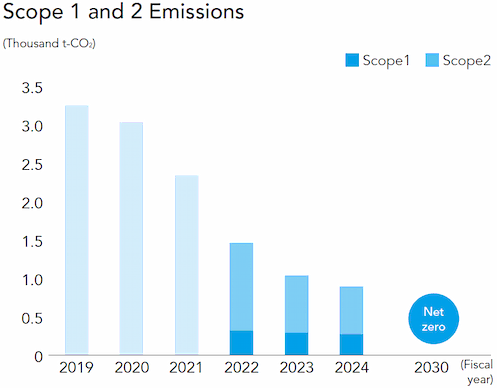
Scope1: Direct GHG emissions from our own business activities
Scope2: Indirect GHG emissions associated with electricity, heat, and steam procured from other companies
DBJ and eight major domestic Group companies have set targets for achieving net zero in-house emissions by fiscal 2030. GHG emissions are measured and tallied at these companies. DBJ continues to promote efforts to reduce GHG emissions, centered on the Sustainability Management Office in the Corporate Planning & Coordination Department.
Scope3: Indirect GHG emissions outside of Scope 1 and 2 (classified into 15 categories depending on the activity)
With the goal of achieving net zero GHG emissions for its investment and loan portfolio by 2050, the DBJ Group has set interim reduction targets for GHG emissions from its investment and loan portfolio to the electric power sector and oil & gas sector, taking into account the characteristics of each sector and the amount of credit exposure. GHG emissions in its portfolio of investments and loans are measured and monitored using the PCAF*1 Standard, which offers financial institutions methods for calculating emissions in each asset class within their investment and loan activities.
- *1PCAF: Partnership for Carbon Accounting Financials
| Indicators for Sectors | Interim Reduction Targets and Approach for GHG Emissions (Scope3) | FY2024.3 Results | |
|---|---|---|---|
| Electric power sector |
|
|
361g-CO2e/kWh |
| Oil & gas sector |
|
|
–11% (compared with fiscal 2022) |
- *2NDC: Nationally Determined Contribution
- *3IEA: International Energy Agency
- *4GHG emissions from the combustion of sold products