DBJ Decarbonisation Seminar
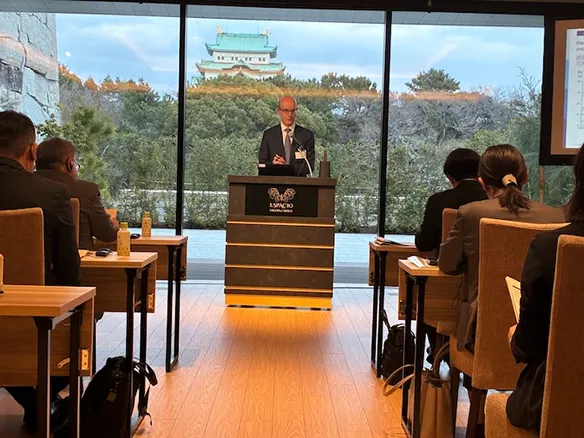
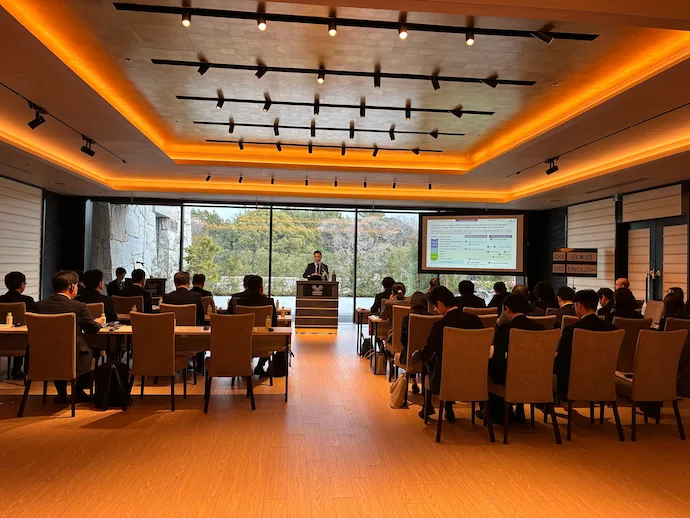
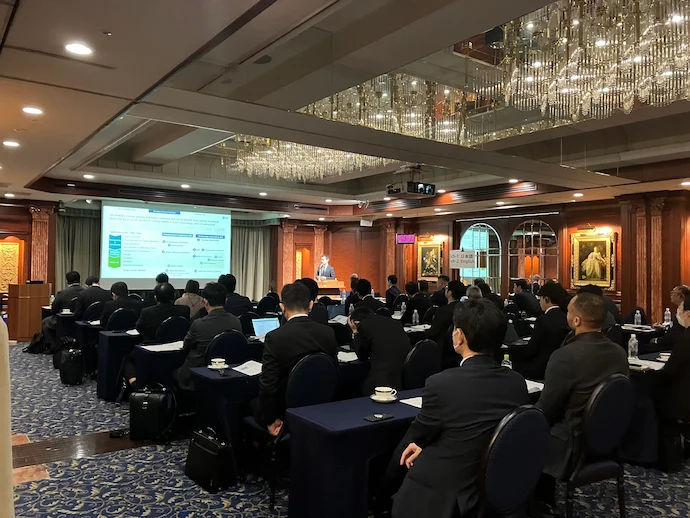
This seminar was held in Hiroshima and Nagoya as an opportunity to gain insights into the latest developments in Europe and to consider their implications for Japanese companies, at a time when growing geopolitical risks are adding uncertainty to the path toward decarbonisation.
At the outset, presentations on recent European trends were delivered by Mr. David Sanders and Mr. Etienne Teyssandier of PA Consulting, the global innovation and transformation consultancy.
Europe’s focus is expanding from “decarbonisation” to “building a resilient society”
Russia’s invasion of Ukraine marked a turning point in Europe’s energy policy, triggering a sharp rise in electricity prices and significantly affecting the energy mix. In addition, growing political uncertainty has created headwinds for momentum toward achieving climate change targets.
Meanwhile, electricity demand is expected to increase in the coming years. This is driven by factors including the emergence of substantial demand for continuously stable power supply in sectors such as data centres and artificial intelligence.
Despite these challenging circumstances, both the public sector and private sector have continued to pursue their efforts toward decarbonisation, adopting a more targeted and strategic approach in response to the changed context. This is because decarbonisation has been redefined as an issue of critical importance from the perspectives of economic security and industrial competitiveness.

PA Consulting
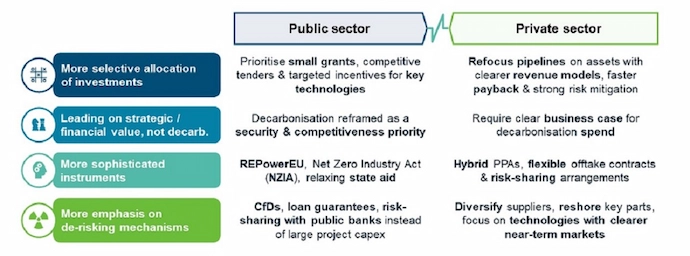
(Source: PA Consulting)
Commercial viability and bankability as key barriers to decarbonisation
As explained by PA Consulting’s David Sanders, the combination of political pressure and increases in electricity demand, together with technological maturation, is reshaping the risk-and-opportunity landscape across the energy value chain for decarbonisation. While conditions vary by sector, there are areas where technological maturity is no longer the primary hurdle; instead, the focus has shifted toward improving profitability and bankability. For Japanese companies as well, there may be opportunities to participate in projects by selecting fields that align with their own risk profiles.
In the United Kingdom and the EU, several policy developments that may affect Japanese companies are scheduled, including the full implementation of the EU Carbon Border Adjustment Mechanism (CBAM)*1 in 2026. There is also the possibility that existing targets may be reviewed, as reflected in the EU’s proposal to reduce its 2035 emissions target for new cars and vans from a 100% to 90% CO₂ reduction. Close attention to trends in the European energy market will therefore be required.
- *1The EU’s Carbon Border Adjustment Mechanism (CBAM) is designed to ensure that imports of certain carbon intensive goods bear a carbon cost equivalent to that faced by EU producers under the EU Emissions Trading System, based on the emissions embedded in their production.

PA Consulting
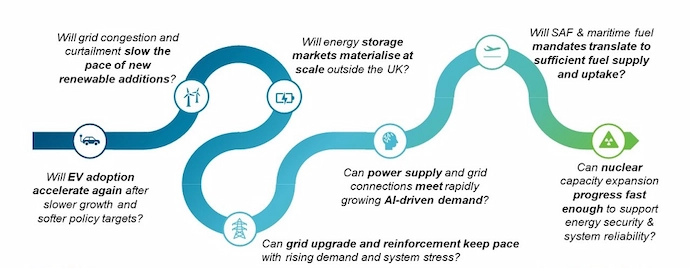
(Source: PA Consulting)
Trends in sustainability management in Japan and cross-border M&A as a strategic tool
Following PA Consulting’s in-depth discussion of developments in the energy and transportation sectors, Ayaka Shinagawa of DBJ’s Sustainable Solutions Department delivered a presentation on trends in sustainability management. This was followed by presentations by Toshiyuki Okubo and Ryosuke Mochizuki of DBJ’s Corporate Strategy Department on trends in the cross-border M&A market.
Sustainability management has evolved beyond conventional CSR activities and individual ESG initiatives. It now involves integrating ESG initiatives into corporate strategy, with the aim of balancing sustainability with “earning power.” In particular, since the Tokyo Stock Exchange requested companies with price-to-book ratios below one to consider improvement measures, companies have been increasingly required to formulate strategies and initiatives that deliver mid- to long-term corporate value enhancement. Sustainability management is positioned as an integrated management theme for achieving sustainable corporate value growth, and going forward, it will be essential for companies to communicate their initiatives to stakeholders and deepen dialogue.
M&A is a means of realizing management strategies that are difficult to achieve internally or that would otherwise require a considerable amount of time. Japanese companies are accelerating their overseas expansion, and cross-border M&A is on an upward trend. In the decarbonisation field as well, M&A involving next-generation energy sources such as hydrogen and ammonia, as well as climate-tech startups, is increasing among Japanese companies. This indicates that M&A is being considered as one of the key tools for developing sustainable business operations.

Sustainable Solutions Department, DBJ

Corporate Strategy Department, DBJ
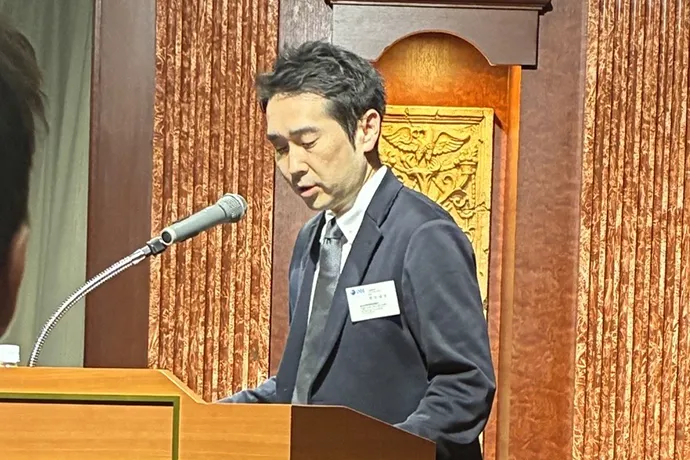
Corporate Strategy Department, DBJ
Conclusion
In recent years, the impacts of climate change—such as the increasing frequency of natural disasters—have become a reality, making decarbonisation an urgent issue across all industries. These impacts also extend throughout entire supply chains. At the same time, the external environment is changing rapidly, making corporate management decisions increasingly complex.
We hope that this seminar serves as a helpful contribution toward addressing the management challenges faced by participating companies.
(Note: Affiliations and titles are as of January 2026.)
この記事は季刊DBJ No.59に掲載されています